Gertler’s Dilemma
A One Act Play by Sandra Harrison
Based on the Life and Death of Mark Gertler, British Artist (1891-1939)
Time: Around 5 pm on the night of June 23, 1939
Place: Mark Gertler’s studio in Highgate, London.
Curtain rises on an art studio where a middle aged man appears. He wipes his hands on a rag, takes off the coat and puts it over a chair. His hair is disheveled and he is constantly looking around. The sun has set and only the early evening sunrays come through the windows leaving the room with many shadows. He walks around the room like he is tidying up. He is restless; constantly putting his fingers through his hair. He checks his watch and continues to roam about the room. Occasionally, he picks up things in the room like a letter, or a paint brush. He picks up a newspaper that is on the floor and is about to throw it away when he decides instead to place it on the table. He sits and reads it.
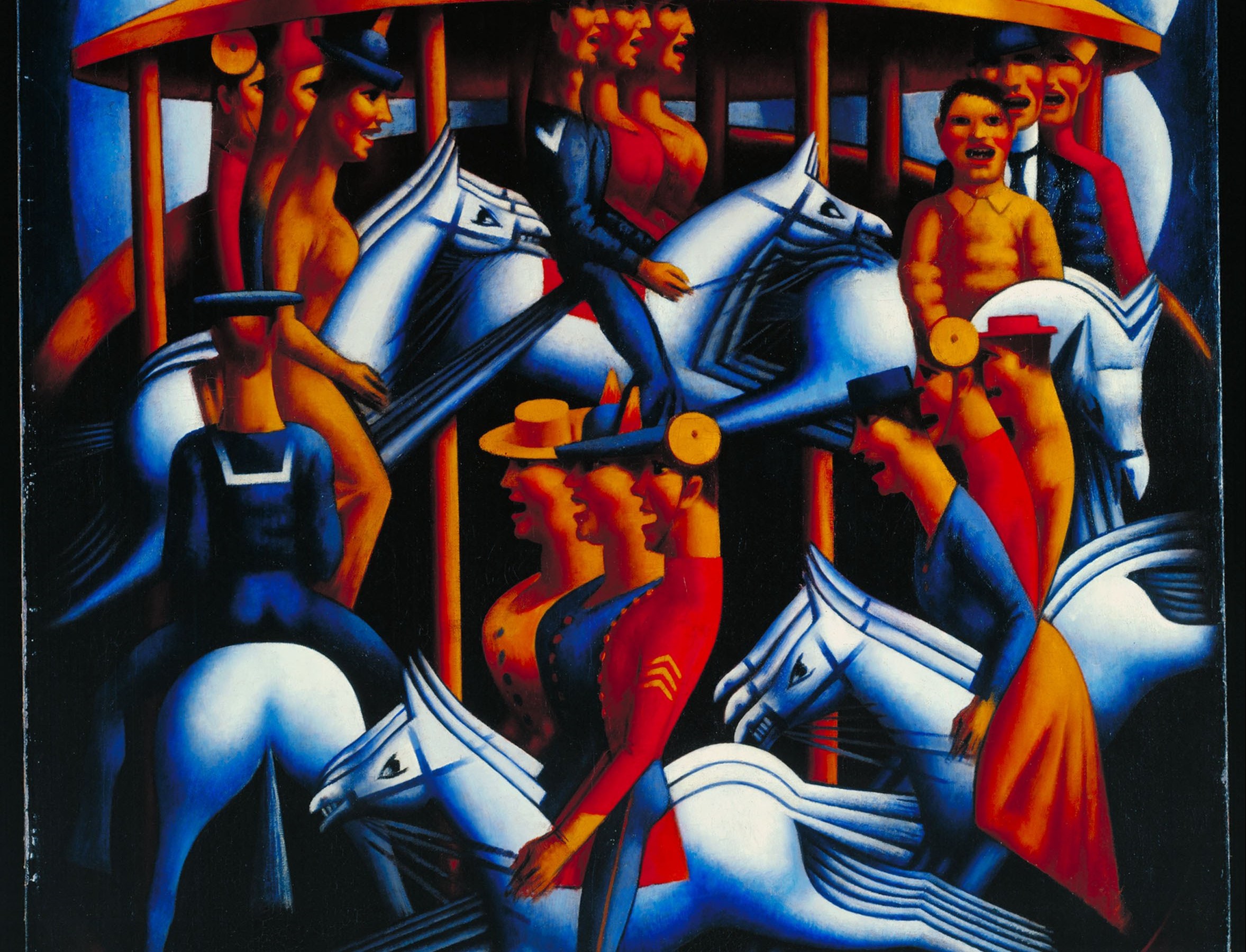
A few minutes later, he puts down the paper, gets up and paces about the room. He stops at one point to pick up a rolled up canvas that he finds in one corner of the room. He unrolls it and it is the “Merry Go Round.” He takes down the canvas that is on the easel in the room and then opens the “Merry Go Round” as if he was to put it on the easel. Then he lets the canvas go so that it rolls back into itself. He walks about the room holding the canvas in one hand. He makes a fist with the other. He is about to throw the canvas to the floor but stops in the middle of the room.
Just then another man appears in the room. He is a younger version of the older man but the only real thing that is similar is their hair style. The younger man is dressed in clothes from an earlier time. The elder man is still in the center of the room and has not noticed the other. He then turns and throws the canvas back into the corner where he had found it. The young man picks it up and unrolls it.
Young Mark: (From the corner) Ah, your masterpiece, “The Merry-go- Round.”
Elder Mark: (Turning, noticing the younger man the elder Mark uses a cockney accent). Not you….? Why do you bother? I will… do it! Just go away!
Young Mark: No. Not, this time. Not, yet. I still think there’s time.
Elder Mark: Time for what?
Young Mark: I think I can talk you out of it. I did before.
Elder Mark: You think, you were the one who talked me out of it. No, it was the blood. I didn’t think that there would be so much. No! You can’t talk me out of this. (He takes the canvas from the younger man and starts to toss it away but the younger stops him and takes the canvas). This time, I intend to go to the end.
Young Mark: (Taking the canvas he sets it up on the easel by clipping it in place). There!
Elder Mark: What are you doing? (He again tries to take the canvas down but the younger man blocks
him) It belongs back there with the dust.
Young Mark: I disagree. It is an important serious work. Perhaps, your best.
Elder Mark: An important work? Rubbish.
Younger Mark: That’s not what D. H said.
Elder Mark: Rubbish! He only saw a copy (and starts to speak very quickly). And, it scared him so much that he did not wish to see the original. His exact words were not very… complementary, if I recall. But, this doesn’t matter. Everyone hated it. Even the people, who didn’t actually see it, hated it. I should nev’er have done it. I should have nev’er painted it… but left it up here (he points to his brain). I wanted people to take me seriously.
Young Mark: But, they did. Let’s see, D H said…
Elder Mark: I know what he said. It doesn’t matter. Everyone hated it.
Young Mark: It scared them. What did Lawrence say? Yes, it shows the, “dark instinctive forces in man.”
Elder Mark: He also said it was … a horrible work…
Young Mark: …and, beautiful. It is the best modern picture I have ever seen. I think it is great… and true.”
Elder Mark: (Ignoring him) And,he also said it was terrifying. He was too frightened to come and look at the original. Saw only the copy.
Younger Mark: But, he did say it was a great work.
Elder Mark: (He takes down the canvas and throws it back into a corner the room) So what? People want pretty pictures, not great works. They want to decorate their homes with pretty little things. What I paint is not for this. I paint with passion and want to inspire. This to me is wonderful. But no one understands them?
Young Mark: You have to be patient. They will understand someday and maybe now with the coming of another war, people will understand it. You should show it again. Remember? You want people to think. You want people to know that the war machine is nothing to take lightly.
Elder Mark: What? War is popular. Pacifists are the unpopular ones. They are… unpatriotic…. unBritish. Men are destined to go to war even when they don’t know what for. Now, this war? Oh, god I can’t imagine. I don’t want to. This German, Hitler. The devil himself. I can’t live through another war. And, to think that Marjorie chooses to stay in France. And, with that man, no less. What about Luke? He would be safer in England? But bloody hell, there’s nothing to do about it.
Young Mark: I agree, that Luke would be safer here, but that’s why you must be here when he returns.
Elder Mark: I knew you would just twist things around. It doesn’t matter about Luke being with me. I was never a good father. All I have done is brought him pain. All those surgeries? The pain? I wish ….. I could have taken them for him. I only brought him pain. What type of father does this to his son? Not a bloody good one, that’s for certain.
Young Mark: How can you think this? Your son loves you and I know he would want you-
Elder Mark: He doesn’t see me. What does it matter?
Young Mark: It will. He expects you to be here. An absent father is always better than a dead one.
Elder Mark: He will understand. Marjorie will explain it to him.
Young Mark: Like this can just be explained away. No one will understand it. So how will he? Not your brothers, nor your sister. Not anyone. They will only think how selfish you were to do such a thing. It is unthinkable, unforgivable. You leave your burdens with them. How pitiful.
Elder Mark: But, what about me? I can’t bear it. I need to end this. I can and I will. It’s my choice, not theirs.
Young Mark: We all have choices. You need to make the right one.. Everyone endures pain. Even people who are happy…
Elder Mark: (Shouting) I am a failure. As a man, a husband, a father, a brother and yes as a painter! I can’t pay for own keep for god’s sake! Never mind provide for others. Just a failure all around.
Young Mark: You are not a failure. And, you’ve been in debt all your life. So that’s it? You can’t pay your bills? You’ve managed before… you will manage.
Elder Mark: The medical bills? The loans from the Jewish Educational Aid Society? It is endless. But this is worse.
Young Mark: Your brothers will help you. Your friends?
Elder Mark: My brothers have done enough. They have their own families to think of. I hate asking for money. I feel ashamed. I can’t even support myself or my family. This was the most difficult thing I ever had to do. Do you know how miserable I must have been to beg?. Asking my family to help me when they are so poor? I felt hopeless and alone.
Young Mark: But…
Elder Mark: I am going to lose my job and then what? War time has never been good for artists. I do not fear being part of it but England is and no war has been good for me. I cannot create the work I want to. I have never been able to do the work that sells. I need to have artist freedom to create great works that I wish to paint. And, not just the ones others wish to buy.
Young Mark: This is nothing new. You have been this way before. You can get through this.
Elder Mark: But do I want to? My desire is gone. I can’t endure life. I am cheapened by my poverty. That’s all there is. Don’t you see? My work, that’s all that’s ever been important to me The roundabout is like life you know, not just war. The ride goes round and round, like the cycle of life. You get on at birth and then off at death. No one has control of this cycle at birth but after that they do, more and more as they stay on the ride. I choose to get off this merry go round. It is my choice and I am ready. Otherwise, I am just waiting to die.
Young Mark: But what about the things in live that people experience that give them great joy and happiness. Accomplishments? Love?
Elder Mark: Yes, now that’s the rub. These things don’t guarantee happiness. Perhaps it is more a state of mind than the experience itself. I have accomplished many things. My work that I thought was great has only been a disappointment. And, love? I know I have loved but was this really loves? Unless one is loved back can one’s love be true? Was I ever loved?
Young Mark: Your mother loved you unconditionally.
Elder Mark: I mean real love. My mother loved me so much but she was my mother. I was her youngest and in her eyes the darling boy who could do no wrong. But, she’s gone. Memories are not enough. She was always there for me but I can not live on memories alone.
Young Mark: There are others.
Elder Mark: Oh? Even my best friends are gone.
Young Mark: So, this is because of Carrington?
Elder Mark: What? I closed doors on this part of my life long ago.
Young Mark: But, her death must have had an effect on you. Her death was a suicide. She shot herself.
Elder Mark: I know this but I don’t think this is about her. Not now. Maybe our break up was. My reason for doing it before. But, not now. This time I am ready.
Young Mark: But, before you didn’t go through with it. Perhaps, you always had the hope that Carrington would come back to you.
Elder Mark: Never.
Young Mark: I think Carrington’s death is a part of this.
Elder Mark: She was gone from my life long before. I knew years ago that I would never have her. Her letters were just her way of keeping me there just in case we things didn’t work out as she planned. Maybe, they never did, for her either but that was her problem.
Young Mark: Her death by her own hand is just an excuse for yours. It is interesting that she used a gun. Just like you had tried to do those first two times.
Elder Mark: She shot herself because of Lynton. He died. It must have painful for her. It just proves that she never, never ever loved me. I was just a thing she played with while it was convenient. She threw me away for a man who could never sexually satisfy her. Can that be love?
Young Mark: For her it had to be enough. What choice did she have? But, I do believe she cared for you. She knew you before Lynton. Those years at the Slade. What about all those times? Those letters must count for something.
Elder Mark: So, what of it? I was the only one she could talk art with and she just strung me along. For ten years. My god, ten years. She drove me crazy. I did things that I still regret. I was like an animal. My lust! My hunger for her. How could I attack Lynton like I did. The things I said. Such hateful things. I loved her. I don’t think anyone could be hers completely. She had so much vitality. She was just one of those women who drove men wild. I lost friends because of my love for her. How could I have blamed them? It was the madness. My jealousy. I could never share her and that was probably the only way one could be with her. The only one she truly wanted was Lynton. He loved her but not sexually. She was jealous of his lovers for God’s sake.
Young Mark: Yes, but you never stopped loving her yourself.
Elder Mark: None of us could. She had that impact on people.
Young Mark: So, then, why not think this through? There will be others.
Elder Mark: You make it sound like finding someone to share your life is so easy. No, I am finished with love.
Young Mark: How harsh.
Elder Mark: Yes, but I have to be realistic. Finding that person that can share everything with you and still love you. That is impossible to find. At least I had my time.
Young Mark: But, there are always other things to consider.
Elder Mark: Yes, but I have my own concerns.
Young Mark: What about being Jewish? Jewish law prohibits suicide. Have you abandoned that too?
Elder Mark: Being Jewish? I have not felt Jewish for a long time. I can’t even speak Yiddish anymore. The last time I was in a synagogue was when I took Marjorie. It was such a shock. I don’t belong in this world anymore. I have no connection to that part of my life anymore. I don’t know how my being Jewish ever helped me.
Young Mark: How you forget. All those paintings. You were hailed for that work.
Elder Mark: I never wanted my Jewishness to define me, or my art.
Young Mark: And, the Jewish Educational Aid Society? What about William Rosenthal and his support?
Elder Mark: Yes, I appreciated this but now the Society wants their money. My Jewishness was helpful but it was also a hindrance. I could never find the place between these worlds that were a part of me. Many people helped me but still I was a failure as a working artist.
Young Mark: There is still time to resolve this. This can be your reason to live. You can still find peace. Go back to your roots.
Elder Mark: I can’t. I won’t. I can’t go back to what I have long forgotten.
Young Mark: Your family can help you. Let them help you. They deserve that right.
Elder Mark: The right? Over my life? My life is in my hands. And, no ones else’s.
Young Mark: No, I do not believe this. You owe people, your life, your being, the your ever essence of life.
Elder Mark: No, no, no! And, besides, it doesn’t matter. I can’t endure.
Young Mark: You have struggled to hard just to give up. There is always tomorrow.
Elder Mark: My isolation is extraordinary. I am alone. Yes, if only I was like my brothers. To be an ordinary workman. I should have been. But, no, I desire perfection and brilliance. How can I endure with an unordinary life. Oh! God! Do I deserve this? To be so tormented by my own ambition? I am cut off from my own family by class. And, by them I have been raised to be equal to a class I hate! They do not understand me, not them. I am an outcast. I laugh at all the dozens of notices of me from before (he goes to his desk and grabs up a papers in his fist and waves them at the younger man). A lot of them praising my talents. Oh! Yes I am quite well known …and yet alone!
Young Mark: You wrote this to Carrington back in 1912.
Elder Mark: Nothing has changed. I do not belong anywhere. I never really fit in to any group or class. Being an artist has done this to me. It isolates me from the rest of society. And, poverty is the root of it all.
Young Mark: And, yet you paint these people in “society,” this world you live in. Your work transcends time, and class. Your friends were of a class outside your own beginnings.
Elder Mark: I needed them to support my work. I entertained them. It served a purpose. Some kept me around for amusement and others…lusted for me.
Young Mark: You were a good looking man. You still are. You know? You still have an attraction. Your students respect you and some even have crushes on you.
(Mark starts gathering rags from around the studio. He then stuffs them under the door and makes sure the windows are air tight and locked. He then takes a mattress and places it under the door knob so that no one can enter from the outside. He turns on the gas and the stove. He lies down on the floor and with open arms and waits).
Elder Mark: (from the floor) You can go now.
Young Mark: No, I think I’ll stay. There is always hope that someone will come.
Elder Mark: Suit yourself. No one is coming. I made sure of it. (And with this said the older man lies still with his arms spread wide. There is a smile on his face).
Young Mark: (stands by as the room darkens).
Addendum:
Mark Gertler died on June 29, 1939, at the age of 47. He was survived by his wife Marjorie (though separated) and their son Luke, as well as his two brothers and two sisters. Mark was buried in Willesden cemetery with a plain gravestone. After his death, there were two exhibits of his work and more recently there was a retrospective at the Ben Uri Gallery in London in 2002.
Mark Gertler likeness was portrayed in some literary works of fiction. His paintings are still being used as covers of books, the inspiration for curriculum and even short films. His works can be found in different parts of the world. Most notable is the “Merry Go Round” which is owned by the Tate of London, England.
Share this: Sandy's Written Creations
















 Sandy's Written Creations